Build and Run
Prerequisites
Run make init once to install the toolchain:
make init
This installs the Rust tools listed below. The other host utilities must be installed separately:
- Rust nightly via
rustup - Target
x86_64-unknown-none - Components
rust-srcandllvm-tools-preview bootimagecargo subcommandgrub2-mkrescue(orgrub-mkrescue),xorriso, GNU Make andtarfor ISO/archive creation- GRUB platform modules:
i386-pcfor legacy BIOS boot,x86_64-efifor Intel Mac/UEFI boot - QEMU (
qemu-system-x86_64) for the run targets mtools(mmd,mcopy) andmkfs.fatfor floppy image creation
Build
Release build (both video modes)
make build
Produces r2.iso. Internally runs two cargo invocations (with -Z build-std=core,compiler_builtins -Z json-target-spec --target x86_64-r2.json):
| Feature flag | Output ELF | Description |
|---|---|---|
kernel_text |
iso/boot/kernel_text.elf |
VGA text-mode path |
kernel_graphics |
iso/boot/kernel_graphics.elf |
VESA framebuffer path |
The feature selects the Multiboot2 header and graphics-session startup policy. The graphics header requests a 32-bit framebuffer without a fixed resolution; GRUB chooses the mode. Both builds share the same kernel subsystems.
Both ELFs are placed inside iso/boot/. build_iso then copies the userland binaries from the apps repository (expected at ../r2_app) into iso/bin/, and grub2-mkrescue assembles the iso/ tree into r2.iso with the modules multiboot2 video video_bochs video_cirrus gfxterm all_video.
The resulting ISO is mounted at /mnt/iso at boot:
| ISO path | Contents |
|---|---|
/boot |
kernel_text.elf, kernel_graphics.elf, GRUB config |
/bin |
Userland programs (eth, wgd, garn, tnt, chat, sh, fsck, nsk, them, hellofs, hello, dish, gfxdemo, routtest, snake, …). Searched by bg/fg when a binary is not in the working directory. |
/games |
Optional DOS games for the THEM emulator (not part of the repository) |
/opt |
Startup script, application configurations, CA bundle, bsh examples and C8 ROMs |
/include, /lib |
TCC headers, startup objects and libraries |
/sound, /pics, /video |
Staged MIDI files, images and films |
The current build_iso target rebuilds Memento through build_desktop, plus
selected C applications (cube, c8, r2sh, tnt, wgd, chat). It copies
other prebuilt binaries from ../r2_app and stages TCC's sysroot, configurations,
media and application data. Build those dependencies first; missing inputs
stop the target. Some inputs are machine-specific, including ../../tcpp/r2
and game directories under the developer's Downloads directory.
Everything outside iso/boot/ is also packed as iso/boot/usb.tar, which GRUB
loads as a module. The kernel mounts that archive at /mnt/tar; it is the
source of programs and data when booted from USB without a storage driver.
See Boot Medium Archive.
Legacy BIOS USB boot
Use r2.iso for a PC booting in legacy BIOS mode. make image_iso requires
GRUB's i386-pc modules and produces a hybrid image with BIOS boot code and
an active MBR partition marker. If x86_64-efi modules are also installed,
the same image includes EFI boot support.
The active marker is forced with xorriso's --mbr-force-bootable option.
Without it, adding EFI modules to the build host can change the image to a
GPT layout whose protective MBR has no active entry. Some BIOS firmware then
omits the USB stick from its boot menu or reports it as unbootable, even though
the image still boots through EFI on a Mac or as a CD in QEMU.
To rebuild an already staged image after this fix:
make image_iso
xorriso -indev r2.iso -report_el_torito plain -report_system_area plain
Expect a BIOS boot image, grub2-mbr in the system area, and an MBR
partition with status 0x80. An additional small active entry can accompany
the GPT protective entry; it does not replace the EFI partition.
Write the rebuilt r2.iso as an image to the whole USB disk, replacing
its contents, rather than to one partition or as a copied file. Select the
legacy USB boot entry in the PC's firmware. r2-efi.iso is EFI-only and
cannot boot a BIOS machine.
Intel Mac USB boot (including MacBook Pro 2012)
grub2-mkrescue includes boot support for the GRUB platforms installed on the
build host. Installing grub2-tools alone can produce a BIOS-only r2.iso.
That image has no EFI loader for the Intel Mac's native USB boot path, even
though it boots in QEMU's default BIOS. make image_iso warns when the host's
standard x86_64-efi module directory is missing.
Install the EFI modules on the Linux build host:
# Fedora
sudo dnf install grub2-efi-x64-modules

# Debian/Ubuntu
sudo apt install grub-efi-amd64-bin
After make build has staged the kernels and applications, create the explicit
EFI image. This target also works with an existing populated iso/ tree:
make image_efi
This produces r2-efi.iso, containing an EFI System Partition and the removable
media loader /EFI/BOOT/BOOTX64.EFI. It rebuilds usb.tar from the staged files
without recompiling the kernels or applications. The target fails with package
instructions if EFI modules are missing. For modules extracted elsewhere, use
make image_efi GRUB_EFI_DIR=/path/to/x86_64-efi; GRUB_MKRESCUE can override
the selected host command.
Flash r2-efi.iso as a disk image to the USB stick, replacing its contents;
copying the ISO file onto a filesystem is insufficient. On the Mac, power on
while holding Option (⌥) and select EFI Boot, then choose the ordinary
graphics GRUB entry. See Apple's startup key
instructions.
Check an image before flashing:
xorriso -indev r2-efi.iso -report_el_torito plain -report_system_area plain
Expect a UEFI boot image and a GPT EFI boot partition. A report containing
only BIOS confirms that the image has no EFI bootloader. If the Mac shows
EFI Boot but reports “no bootable device” before the GRUB menu appears,
verify which image was flashed and how it was written: the boot picker entry
alone does not establish that R2's loader was reached. A failure after the GRUB
menu is a different stage; record its exact message.
EFI boots initialize native xHCI USB keyboard support automatically. Connect an external USB keyboard before booting; the USB keyboard via xHCI graphics entry enables the same driver explicitly. It supports HID boot keyboards, including keyboards behind USB2 hubs, and routes the switchable USB2 ports on Intel's 2012 Panther Point controller to xHCI.
The built-in keyboard may be on an EHCI-only port. USB trackpads, USB mice, and
runtime keyboard attachment are not supported. See
USB keyboard support.
Avoid the PS/2 input only entries (usb=os) on a Mac: they stop the USB
controllers without starting the keyboard driver.
On EFI, the text mode entries use the framebuffer-capable kernel with
console=fb. R2 draws an 80x25 text console on the RGB framebuffer and starts
the kernel shell instead of Memento. This avoids GRUB's “no console will be
available” warning for a VGA-only kernel and makes commands such as nic
visible. BIOS text entries continue to use the VGA text kernel.
If ETH exits immediately, boot text mode, USB keyboard via xHCI and run
nic. It now lists PCI network controllers even when no Ethernet driver is
registered, including vendor/device IDs and available R2 backends. In Memento,
open /mnt/tmp/NETINFO.TXT in the file browser or run
cat /mnt/tmp/NETINFO.TXT in a shell window. The file is generated at boot
and refreshed when ETH registration succeeds or fails.
R2 supports RTL8139, selected Intel e1000/e1000e/PCH Ethernet controllers,
and the wired Broadcom BCM57765 (14e4:16b4). The BCM57765 backend sets up
copper autonegotiation and polled packet rings; it does not drive the Mac's
wireless controller. Its initialization stage, PHY, link speed and ring state
appear in nic and NETINFO.TXT. BCM57765 hardware traffic still needs
validation on a physical Mac; QEMU checks only the existing boot/NIC paths.
An unsupported controller requires its own driver; an Ethernet cable or DHCP
settings cannot fix that. Serving GARN at http://localhost uses the kernel's
loopback path and does not establish support for the physical Ethernet port.
Graphics session
The graphics kernel maps the framebuffer write-combining at boot. When GRUB
provides an RGB framebuffer, it starts neither kshell nor kclock; Memento
owns the ordinary graphics session. An EFI text entry uses console=fb to
start a visible kernel shell on that framebuffer instead.
In an ordinary graphics session, init_rc runs the startup script and then
starts Memento in the foreground.
Use the floppy's INIT.RC when present; an empty or missing script on the
graphics build falls back to /mnt/tar/opt/init.rc, then /mnt/iso/opt/init.rc.
The build copies configs/init.rc to both boot-medium copies. Keep fg memento
out of the graphics startup script, since the session launcher starts it itself.
Memento scales its desktop by the largest whole number that leaves at least
640×400 pixels (1920×1080 gives 960×540 at 2×), uses 256 colours, and sends
changed rows through indexed blitting.
To request a particular GRUB mode, add set gfxpayload=1920x1080x32 after
multiboot2 and before boot in the graphics menu entry. The
GRUB Multiboot loader
resets gfxpayload from the kernel header when it loads the kernel.
The launcher stays alive as the desktop supervisor. After a cooperative
Jug relaunch, it preserves Memento's arguments, adds --relaunch
and starts the updated copy without rerunning the script or rebooting. An
ordinary exit, kill or crash restarts the machine if that desktop ran for at
least five seconds; a failed or shorter launch ends the supervisor without
restarting. See desktop relaunch ABI.
On the text kernel, use fg memento to run the 640×400 VGA desktop and return
to the rescue shell when it exits.
WireGuard applications
The image build rebuilds the C wgd, sh and tnt applications and relinks chat. It packages wgd.elf and /opt/wgd/wgd.cfg.example into the ISO and boot archive; the example has key placeholders and needs a separate completed configuration. Starting the daemon is a shell or INIT.RC choice.
Rebuild and boot the kernel too: wgd and the shell's subnet ping/traceroute commands require syscall 0x44 ABI 2. Relink other libcr2 TCP servers to preserve the tunnel destination as their reply source. See WireGuard for configuration, physical network prerequisites, diagnostics and entropy fallback.
Debug build
Build both release kernels once before making a debug image: the debug target
replaces only kernel_text.elf, while GRUB still includes the graphics entry.
make build_debug
Runs compile_kernel_debug and build_iso. Builds the text-mode kernel with features kernel_text,serial_debug. Serial debug output is written to COM1 (rprint!/rprintb!/rprintn! macros). Note: serial debug disables SLIP networking (both use COM1).
Optional extra features:
make build_debug EXTRA_FEATURES=serial_debug
Clean
make clean # cargo clean
Target Specification (x86_64-r2.json)
| Field | Value |
|---|---|
llvm-target |
x86_64-unknown-none |
os |
none |
linker |
rust-lld (LLD) |
relocation-model |
static |
panic-strategy |
abort |
disable-redzone |
true |
features |
-mmx,-sse,+soft-float |
exe-suffix |
.elf |
SSE is disabled at the target level; SSE is re-enabled at runtime by init::cpu::enable_sse (after the kernel stack is set up). The soft-float feature prevents LLVM from emitting SSE instructions before that point.
Linker Script (linker.ld)
The kernel is linked starting at physical address 0x100000 (1 MiB).
| Region | Address / size | Notes |
|---|---|---|
.multiboot2_header |
0x100000 (4 KiB aligned) |
GRUB Multiboot2 header |
.text |
follows | All code |
.rodata |
follows | Read-only data, embedded fonts |
.data + .dma |
follows | Writable globals; .dma section holds the DMA: [u8; 512] floppy buffer at a known physical address |
.bss |
follows | Zero-initialised statics |
.gdt |
follows | GDT descriptor (assembly) |
.idt |
follows | IDT descriptor (assembly) |
.boot_reserved (NOLOAD) |
follows, 16-byte aligned | Covers stack, heap and page tables so GRUB does not place a module over them |
__stack_bottom/top |
64 KiB in .boot_reserved |
Kernel boot stack |
__heap_start/end |
64 KiB in .boot_reserved |
Kernel linked-list heap |
p4_table |
4 KiB aligned, in .boot_reserved |
PML4 page table |
p3_fb_table |
4 KiB in .boot_reserved |
P3 table for framebuffer mapping |
.user_task |
0x650000 |
Unused user-task section placeholder |
.dma (DMA buffer) |
0x80000 (512-byte aligned) |
Physical DMA target for ISA DMA channel 2 |
The p2_table, p2_high_tables, p3_table, ist0/ist1_stack (16 KiB each: the double fault runs on ist0_stack via TSS ist1, the page fault on ist1_stack via ist2), tss64, multiboot_ptr, and debug_flag symbols all live in assembly .bss in boot.asm.
Boot Flow
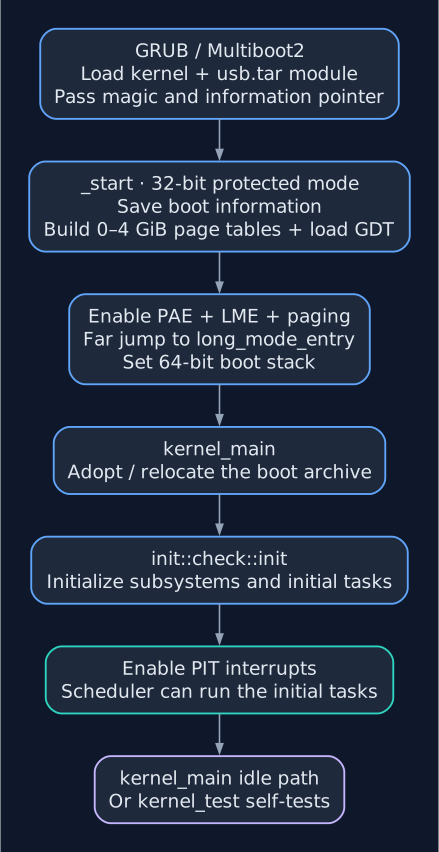
Boot handoff from GRUB to Rust and the scheduler. The assembly operations below expand the middle stages; subsystem initialization expands the final setup.
GRUB (Multiboot2)
  │  loads r2.iso, selects kernel ELF
  │  passes Multiboot2 info pointer in EBX, magic in EAX
  ▼
_start  (boot.asm, 32-bit protected mode)
  ├── saves EBX/EAX → [multiboot_ptr] / [multiboot_magic]
  ├── loads P4 table address into CR3
  ├── set_up_page_tables()
  │     identity-maps 1 GiB via P2 (512 × 2 MiB huge pages)
  │     identity-maps 1–4 GiB via 3 more P2 tables (p2_high_tables, 2 MiB pages;
  │     not 1 GiB pages, which need the optional pdpe1gb CPU feature)
  │     marks P2[2..4] USER+WRITE (0x400000–0xA00000, userland range)
  ├── load_gdt()    — lgdt from gdt_descriptor
  ├── load_idt()    — lidt (empty; real IDT installed by init later)
  ├── set segment registers to data selector 0x10
  ├── enable_paging()
  │     CR4 bit 5 (PAE), EFER bit 8 (LME), CR0 bit 31 (PG)
  └── far jump to long_mode_entry (selector 0x08 = 64-bit code)
  ▼
long_mode_entry  (boot.asm, 64-bit long mode)
  ├── TLB flush (mov cr3, cr3)
  ├── set segment registers to 0x10
  ├── RSP ← __stack_top  (64 KiB kernel stack)
  └── call kernel_main(multiboot_magic, multiboot_ptr)
  ▼
kernel_main  (src/main.rs)
  ├── fs::ustar::module::adopt(multiboot_ptr) — relocate boot archive if needed
  ├── init::check::init(multiboot_ptr)        — subsystem initialization
  │     (see Boot and Initialization)
  └── task::scheduler::idle(0xff)        — enters scheduler; never returns
GDT Layout (from boot.asm)
| Selector | Descriptor | Description |
|---|---|---|
0x00 |
null | Required null descriptor |
0x08 |
0x00AF9A000000FFFF |
Kernel code (64-bit, DPL=0) |
0x10 |
0x00AF92000000FFFF |
Kernel data (DPL=0) |
0x18 |
0x00affa000000ffff |
User code (64-bit, DPL=3) |
0x20 |
0x00aff2000000ffff |
User data (DPL=3) |
0x28 |
TSS descriptor (patched at runtime) | 64-bit TSS |
The TSS descriptor at 0x28 is initially a placeholder; init::idt::setup_tss_descriptor overwrites it with the correct base address and limit before ltr 0x28 is issued.
Floppy Image (make build_floppy)
Creates a 1.44 MB FAT12 floppy image (fat.img by default, override with FLOPPY_IMAGE=):
make build_floppy
make build_floppy FLOPPY_IMAGE=my.img
ddcreates a blank 2880-sector image.mkfs.fat -F 12formats it.mmdcreates directories:BIN,GARN,GFX,SLIP,SOUND,THEM,DYNA.mcopycopies data files and demos (from../r2_app/and this repository):
| Floppy path | Source |
|---|---|
INIT.RC |
configs/init.rc |
GARN/GARN.CFG, GARN/INDEX.HTM, GARN/HELLO.TXT, GARN/FAVICON.ICO, GARN/SOCKETS.JSN |
GARN web server config and content |
GFX/CUBE.ELF, GFX/GFXTEST.ELF |
Graphics demos; Memento is in the boot medium's bin/ |
SLIP/ICMPR.ELF |
ICMP responder over SLIP |
SOUND/*.MID |
MIDI files for syscall 0x1b |
THEM/PRG0.BIN, THEM/VLAK.COM |
Real-mode programs for the THEM emulator |
The main programs are no longer copied to the floppy: they live in /mnt/iso/bin on the ISO, which leaves the 1.44 MB floppy for data.
The INIT.RC file is the startup script parsed by init_rc at boot (see below).
Startup Script (configs/init.rc)
init_rc reads up to 1024 bytes of INIT.RC from the floppy root. On the
graphics build, an empty or missing script falls back to the boot medium's
opt/init.rc as described in Graphics Session. Each
non-blank, non-comment line goes through cmd::handle, the same dispatcher
used by the rescue shell. Only the file's actual length is interpreted.
Example startup script (the checked-in configs/init.rc also contains local
working-directory choices):
# Start network driver
bg eth

# Start TNT with config
bg tnt eth

# Start GARN web server
bg garn --config /mnt/tar/opt/garn/garn.cfg

echo INIT.RC done
Binary names are resolved like in the shell: /mnt/tmp/jug first for downloaded updates, then the working directory, then /mnt/tar/bin and /mnt/iso/bin, so bg eth works without the program being on the floppy. init_rc starts at /, which holds no files, so until a cd it takes shipped programs from the bin directories. A fg line parks init_rc until that program exits.
Lines starting with # are ignored. Trailing \r is stripped (DOS line endings tolerated).
Taking USB from the Firmware
With usb=os on the kernel's command line, the kernel takes the USB host controllers from the firmware at boot, before it sets up the PS/2 mouse (src/usb/, the boot line Taking the USB controllers from the firmware). grub.cfg has a text and a graphics entry with it, marked PS/2 input only. In the GRUB menu you can also press e and add usb=os to the multiboot2 line.
Use it on real hardware when pulling out the USB stick freezes the machine. The firmware's SMM code still drives the controllers to emulate a PS/2 keyboard and mouse. A stick pulled out is an SMI the firmware may spend seconds on, and the kernel cannot mask it. This ownership-only mode stops the controllers, leaving input to real PS/2 devices. The boot line reads FAIL if a controller's registers were out of reach, or if the firmware did not let go and had to be overruled. In that case, look for XHCI/EHCI Hand-off in the firmware setup and turn it on. The kernel shell's usb command shows the state of each controller, and usb take does the same handoff later, also stopping the native keyboard driver.
For native USB keyboard input, use usb=xhci instead. EFI boots enable it
automatically unless usb=os or usb=firmware is present. BIOS boots retain
firmware input by default. See USB keyboard support
for device support and current limits.
Run Targets
| Make target | Description |
|---|---|
make run_iso |
QEMU with CD-ROM only, 2 GB RAM, VGA std, serial PTY |
make run_iso_floppy |
Recreates fat.img, then boots with the floppy and PC speaker audio; existing image data is overwritten |
make run_iso_net |
CD + floppy + RTL8139 NIC on tap0 + PC speaker audio, GTK display, serial PTY |
make run_iso_debug |
CD + floppy, 4 GB RAM, serial → stdio, audio, no-reboot/no-shutdown |
make run_iso_debug_int |
Same + -d int,cpu_reset,page (interrupt tracing) |
make run_iso_pty PTY_NUMBER=ptyN |
CD only, serial on specific PTY |
make run_iso_usb |
CD replaced by /dev/sdb (USB stick) |
make run_iso_floppy_drive |
Live floppy /dev/sda (requires sudo) |
Standard run with networking:
make run_iso_net
QEMU network setup assumes tap0 is already created on the host. The kernel probes RTL8139 first, then supported Intel controllers, then BCM57765 via PCI scan. To test Intel in QEMU, replace the target's -device rtl8139,netdev=net0 with -device e1000,netdev=net0 or -device e1000e,netdev=net0; see Hardware Layer.
sudo ip tuntap add dev tap0 mode tap
sudo ip link set tap0 up
sudo ip addr add 10.3.4.1/24 dev tap0
Before starting QEMU, run_iso_net also runs a few best-effort host tweaks with sudo (each one ignored if it fails): it sets the tap0 MAC address, puts tap0 and 10.3.4.0/24 into the firewalld trusted zone, disables reverse-path filtering on tap0, flushes conntrack, and adds an nftables raw-table accept rule for traffic from tap0. The guest uses 10.3.4.2 by default, with the host at 10.3.4.1.
Tests
Kernel self-test (QEMU)
make test_kernel
Builds with features kernel_test,kernel_text into target/ktest, then boots
the existing r2.iso in headless QEMU with the isa-debug-exit device (iobase=0xf4) and serial on stdio. With kernel_test enabled, kernel_main runs ktest::run_tests() right after init::check::init instead of entering the idle loop. Each check uses kassert!, which exits QEMU on the first failure. QEMU exit code 33 (0x10 << 1 | 1) means all tests passed and prints TESTS PASSED; anything else prints TESTS FAILED.
The target currently does not copy the test ELF into the ISO, and the checked-in
GRUB default selects the graphics kernel. For a self-test run, build a separate
ISO with a single text-kernel entry. Start after a normal make build has
created iso/boot/usb.tar:
cargo build --features kernel_test,kernel_text --target-dir target/ktest \
  -Z build-std=core,compiler_builtins -Z json-target-spec --target x86_64-r2.json
mkdir -p /tmp/r2-selftest/boot/grub
cp target/ktest/x86_64-r2/debug/kernel.elf /tmp/r2-selftest/boot/kernel_text.elf
cp iso/boot/usb.tar /tmp/r2-selftest/boot/usb.tar
cat > /tmp/r2-selftest/boot/grub/grub.cfg <<'EOF'
set timeout=0
set default=0
menuentry "r2 kernel self-test" {
    multiboot2 /boot/kernel_text.elf
    module2 /boot/usb.tar usb
    boot
}
EOF
grub2-mkrescue -o /tmp/r2-selftest.iso /tmp/r2-selftest
qemu-system-x86_64 -boot d -m 256M -cdrom /tmp/r2-selftest.iso -fda fat.img \
  -device isa-debug-exit,iobase=0xf4,iosize=0x04 -serial stdio -display none -no-reboot
Check QEMU's exit status (33 for success). These temporary files leave the
regular release ISO and GRUB menu intact.
The timer is already running when the tests start, so the processes the floppy's INIT.RC starts (eth, tnt, garn) run alongside them, and a run can fail now and then because of it. A floppy whose INIT.RC is a single NUL byte gives a quiet run. The tests also expect a floppy: test_vfs_resolve needs /mnt/fat, which is mounted only when one is found.
Tests in src/ktest.rs:
| Test | Checks |
|---|---|
test_fat83 |
8.3 name conversion |
test_heap_alloc |
userland heap malloc/free |
test_heap_grow |
filling the 4 MiB heap grows it into its extension, which is user accessible, writable and given back by free |
test_vfs_resolve |
/mnt/fat and /mnt/iso prefix resolution |
test_path_normalize |
joining, .. and relative paths in vfs::normalize_path |
test_mount_dir |
/ lists mnt, /mnt lists the mount points with their types, and a mount or a path leading nowhere is no mount directory |
test_kerndbg_log |
init left its debug log in /mnt/tmp/KERNDBG.LOG |
test_memdisk_place |
the RAM disk is a sixteenth of the RAM in 2 MiB pages, in usable memory below 4 GiB, clear of the fixed regions and the archive |
test_memdisk |
the RAM disk at /mnt/tmp is FAT16 (with clusters of several sectors from 64 MiB): a file over three clusters read whole and from inside its second, a subdirectory grown past its first cluster, write_file_at appending and leaving a gap that reads back as zeros, delete |
test_small_disks |
disks carved out of the RAM disk's memory: FAT12 at 2 MiB, FAT16 at 4 MiB; a file across the FAT12 entry that straddles two FAT sectors, and a full disk that keeps earlier files intact |
test_slot_layout |
all 32 user stacks avoid the image window, frame addresses match slots, and the kernel ends below user memory |
scheduler::test_desktop_relaunch |
capability registration, request/poll, one-shot commit, parent identity and unsupported-launch handling |
Host unit tests
make test
Compiles and runs tests/unit/main.rs and tests/network/main.rs as host Rust
test binaries (no QEMU). Pure modules are included directly by #[path]; the
network suite runs the production NIC/accounting and registry code with
hardware and scheduler stand-ins:
| File | Covers |
|---|---|
tests/unit/fat12.rs |
8.3 name conversion (a copy of fat83) |
tests/unit/midi.rs |
Standard MIDI File parsing and the monophonic sequencer (src/audio/smf.rs) |
tests/unit/path.rs |
Path normalisation (src/fs/vfs/path.rs) |
tests/unit/elf_path.rs |
Bare names, absolute executable paths, invalid input and length limits |
tests/unit/desktop.rs |
Preserving desktop arguments, adding --relaunch once, invalid and oversized commands |
tests/unit/bcm57765.rs |
BCM57765 descriptor ownership/wraparound, PCI power state, MAC validation, bounded reset/PHY waits and copper link resolution with a register model |
tests/unit/calendar_clock.rs |
Gregorian dates and CMOS decoding, clock adjustments, midnight rollover and independent uptime |
tests/network/main.rs |
NIC byte accounting, held frames, failed TX, independent TCP/UDP routing and ownership, ARP fanout, cleanup and layout sizes |
Memento time synchronization
make -C ../r2_app/cpp/memento-hello settingstest ntptest nettest
python3 tests/time/qemu_ntp.py --grub-efi-dir /usr/lib/grub/x86_64-efi
The host suites test settings validation/layout, SNTP reply validation,
timeouts, retry limits and clock application. The VM test requires freshly
staged kernels and Memento in iso/boot/usb.tar, QEMU and OVMF. It uses a
local Ethernet peer for DHCP, ARP, UDP DNS and NTP, sends a stale reply before a valid
2040 timestamp, and checks the kernel wall clock and PIT tick rate. No Internet
connection is needed. Output and a screenshot go to /tmp/r2-ntp-vm by default.
Jug publisher tests
PYTHONDONTWRITEBYTECODE=1 python3 -m unittest discover -s tests/jug_publish -v
Exercises the SSH publication receiver through a local substitute. See Development checks for coverage.
Code Analysis
make clippy          # cargo clippy --release, all warnings as errors
make sonar_check     # SonarQube scan (requires SONAR_HOST_URL + SONAR_TOKEN env vars)
Documentation Site
From the repository root, install the documentation dependencies and preview:
python3 -m pip install -r docs/requirements.txt
mkdocs serve
Open http://localhost:8009; mkdocs.yml sets the preview port to 8009.
Build and validate the site without writing generated files into the checkout:
mkdocs build --strict --clean --site-dir /tmp/r2-docs-site
Every Markdown page belongs in mkdocs.yml's nav. Use relative .md links
between pages, with heading fragments when useful, so links work both in the
repository and after rendering. Link back to the section overview and to the
relevant ABI or SDK guide. Downloads and images must live under docs/;
paths to ../configs or ../src do not become site assets. The downloadable
Nginx examples in docs/assets/configs/ mirror configs/jug-*.nginx.example;
refresh them when those source snippets change. Strict validation reports
missing navigation entries, missing files and broken heading anchors.
docs/docs_theme/main.html adds the breadcrumb trail, with styles in
docs/assets/stylesheets/navigation.css. Section overview files keep their
existing URLs; the sidebar, tabs and previous/next links come from the Material
theme and nav.
Diagrams are SVG images with editable Graphviz .dot sources in
docs/assets/diagrams/. Click a diagram to open its full-size export. To update
them, edit the source and regenerate with Graphviz installed (dot on PATH):
python3 utils/render_docs_diagrams.py
The renderer also creates the fixed-memory-pool chart from the capacities in
memory_budget(). Keep those values aligned with src/task/process.rs,
src/mem/pages.rs and src/mem/uheap.rs. Chart bars show reserved capacity,
not measured usage. Regeneration needs Python's standard library and Graphviz;
viewing the committed SVGs needs no extra site plugin.
Related documentation: Documentation home, Kernel Shell, SDK Overview, Boot and Initialization.