Video Overview
Two Output Paths
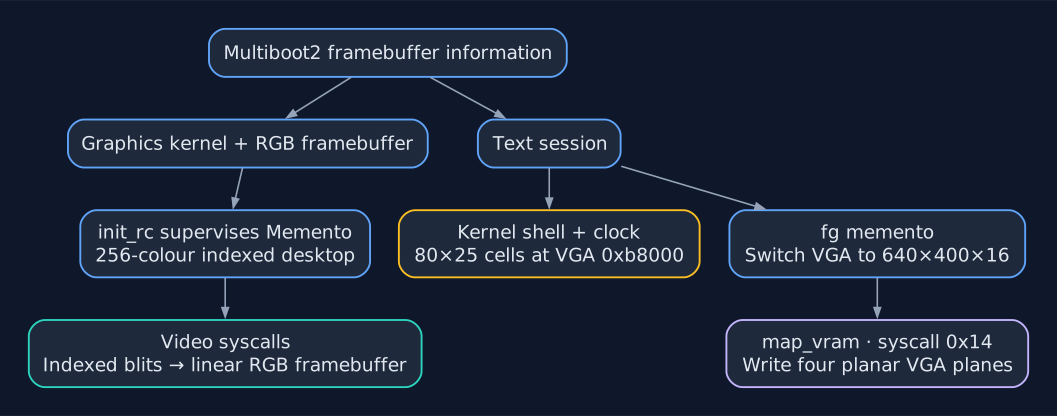
Session and display paths. The automatic desktop requires the graphics kernel and an RGB framebuffer; a text-session desktop is started explicitly.
The kernel supports two independent video paths selected at boot based on what the bootloader provides:
| Path | Source | Mode | Driver |
|---|---|---|---|
| VESA framebuffer | Multiboot2 framebuffer tag | Linear pixel buffer | video/mode.rs |
| VGA text mode | Legacy BIOS/VGA | 80×25 character cells | video/vga.rs |
| Framebuffer text console | EFI text entries (console=fb) |
80×25 cells drawn as pixels | video/console.rs, video/vga.rs |
The kernel console writes boot status to VGA text memory at 0xB8000. When
GRUB selects an RGB framebuffer that text memory is not visible; Memento
provides the graphics session instead of the kernel shell and clock. See
Graphics Session.
EFI text entries select the framebuffer console, which keeps the shell visible on systems without a VGA text display. See Text Mode Writer.
Boot-Time Detection
init::check::init() parses the Multiboot2 information structure passed by the bootloader. When a framebuffer tag (type 8) is found, the kernel fills FRAMEBUFFER_PTR:
pub static mut FRAMEBUFFER_PTR: FramebufferTag = FramebufferTag {
    addr:   0,
    pitch:  0,
    width:  0,
    height: 0,
    bpp:    0,
    fb_type: 0,
};
FramebufferTag mirrors the Multiboot2 tag layout:
| Field | Type | Description |
|---|---|---|
addr |
u64 |
Physical address of the framebuffer |
pitch |
u32 |
Bytes per scan line |
width |
u32 |
Width in pixels |
height |
u32 |
Height in pixels |
bpp |
u8 |
Bits per pixel (16 or 32) |
fb_type |
u8 |
1 = RGB, 2 = EGA text |
After parsing, VIDEO_MODE is set once and stays fixed for the lifetime of the
kernel. For an RGB framebuffer, video::wc::map_write_combining changes PAT
entry 1 to write-combining and selects it on the framebuffer's 2 MiB pages.
This happens before process page tables are created. See
Boot and Initialization.
VideoMode Enum (video/mode.rs)
pub enum VideoMode {
    Framebuffer {
        address: u64,
        pitch:   u32,
        width:   u32,
        height:  u32,
        bpp:     u8,
    },
    TextMode,
}

pub static mut VIDEO_MODE: Option<VideoMode> = None;
VIDEO_MODE is read by pixel-writing helpers and video syscalls to dispatch to the correct path.
Pixel Writing
put_pixel(x: u32, y: u32, r: u8, g: u8, b: u8) in video/mode.rs writes a single pixel into the VESA framebuffer. The byte offset is:
offset = y * pitch + x * (bpp / 8)
Pixel encoding by bpp:
| bpp | Format | Encoding |
|---|---|---|
| 32 | 0x00RRGGBB |
(r as u32) << 16 \| (g as u32) << 8 \| b as u32 |
| 16 | RGB565 | ((r >> 3) << 11) \| ((g >> 2) << 5) \| (b >> 3) |
Other bit depths are ignored (no-op).
Text-Mode Character Writing
put_char(x: u32, y: u32, ch: u8, color: u8) writes a character cell to the VGA text buffer at 0xB8000. Each cell is 2 bytes: character byte then attribute byte (color). The cell offset is:
offset = (y * 80 + x) * 2
This function is independent of the Writer struct — it is a direct write used by some low-level paths.
Boot Status Display (video/sysprint.rs)
sysprint.rs provides a structured boot-status output layer that sits on top of the VGA text Writer. It maintains SYSBUFFER: Mutex<Buffer> — a 24-line display buffer (kept separate from the scrolling writer so status lines stay visible).
pub enum Result {
    Unknown,
    Passed,
    Failed,
    Skipped,
}
Each subsystem check (heap, processes, network, etc.) prints a line using print_result(name, result). Output format:
[  OK  ]  kernel heap
[ FAIL ]  some subsystem
[ SKIP ]  optional feature
[UNKNWN]  unverified
Colors are applied per Result variant using VGA attribute bytes.
Video Syscalls
| Syscall | Number | Description |
|---|---|---|
put_pixel |
0x12 |
Write single pixel at (x, y) with RGB color |
blit_mode13 |
0x13 |
Blit a 320×200 byte array into VGA mode 13h VRAM |
map_vram |
0x14 |
Map VGA VRAM (0xA00_000) into the calling process's page table |
set_video_mode |
0x15 |
Switch VGA hardware mode (0x03 / 0x0D / 0x12 / 0x13) |
get_fb_info |
0x16 |
Copy FRAMEBUFFER_PTR fields into userland-supplied buffer |
blit_buffer |
0x17 |
Copy userland pixel buffer into VESA framebuffer |
get_kernel_font |
0x18 |
Copy the embedded 8×16 CP850 font bitmap into userland buffer |
blit_indexed |
0x19 |
Scale palette-indexed frames, update row bands and publish completed presentations |
capture |
0x1c |
Copy framebuffer rows to a packed 32-bit pixel buffer |
capture_rgb24 |
0x1d |
Capture and scale to tightly packed RGB24, using a completed snapshot at 640×480 when available |
See Video and Audio syscalls for request layouts, presentation transactions and capture retry rules.
Pointer Constraints
Buffers passed to video syscalls must lie wholly inside the program image and initial stacks (0x400_000 – 0xA00_000) or wholly inside the userland heap (0xC00_000 – 0xFFF_FFF) or its allocated extension. See Pointer Arguments. The whole buffer is checked: 64000 bytes for 0x13, width × height × 4 for 0x17.
The exception is map_vram (0x14), which maps 0xA00_000 into the calling process's page table using a P1 (4 KiB) sub-table allocated from PAGE_TABLE_POOL. After map_vram, the process can write to VGA VRAM directly at that virtual address without going through a syscall.
Kernel Font (VGA_FONT_8X16)
A complete 8×16 pixel CP850 font (256 glyphs × 16 rows × 1 byte per row = 4096 bytes) is embedded as a static array in video/vga_hw.rs. It is used:
- By
restore_font()when switching back to VGA text mode (mode 0x03) — loaded into VGA plane 2 via planar write mode. - Via syscall
0x18— returned to userland for software font rendering in pixel modes.
Related documentation: Kernel Internals, VGA, Video and Audio ABI, Memento.