IPC
Inter-process communication techniques.
Message Queue
Each process holds one Port (index 0). A Port contains a fixed-size circular
Queue of up to 64 Message entries. Networking and the legacy send syscall
share this queue.
struct Message {
    port_id:  usize,   // frame length when used for network delivery; otherwise 0
    src_pid:  usize,   // sender scheduler slot (despite the field name)
    dst_pid:  usize,   // target scheduler slot
    buf_addr: u64,     // payload address; network frames own a FRAME_BUF slot
}
Legacy send path
- The caller copies its payload into
MSG_BUF[0](512-byte kernel buffer). - The current syscall
0x36constructs aMessagewithbuf_addr = 512, rather than the address ofMSG_BUF[0]. scheduler::push_msg(target_slot, msg)attempts to enqueue it and wakes the target. A full queue or contended scheduler lock is not reported to the caller.
This is a legacy implementation limitation: the receive path treats buf_addr
as an address, so these messages do not deliver the copied payload correctly.
Argument 1 is also used as a scheduler slot, not a public PID. See
syscall 0x36.
Network delivery uses owned frame buffers and a checked enqueue path instead.
Receiving (syscall 0x35 / receive_data)
scheduler::pop_msg(current_pid)dequeues the front message.- If a message is available, the kernel validates and copies
port_idbytes, or 512 bytes whenport_idis zero, into the caller's buffer. Network frame storage is released after the copy. The return value is the copied length. - If the queue is empty and Argument 1 is zero, the call returns
0immediately. - If the queue is empty and Argument 1 is nonzero, the caller is marked
Blockeduntil delivery wakes it. The empty-queue call can return0after wakeup; call again to obtain the frame.
Each call consumes at most one message. There is no peek operation; both
blocking and non-blocking reads remove a queued message. The syscall receives
no destination capacity: reserve a 2 KiB buffer for Ethernet frames. See
syscall 0x35.
Network Delivery (NIC → userland)
The selected RTL8139 or Intel NIC is polled in scheduler_schedule before
the round-robin pick. netdrv::poll_and_deliver handles up to 16 frames per
tick, routes each to a TCP port owner, tunnel daemon or global driver, and
queues it with try_push_msg. Each frame owns one of 64 separate 2 KiB
buffers until received or its owner exits. A frame that cannot be queued is
held at the ring head and retried, with a 200-tick limit for an unresponsive
receiver. See Receive Path.
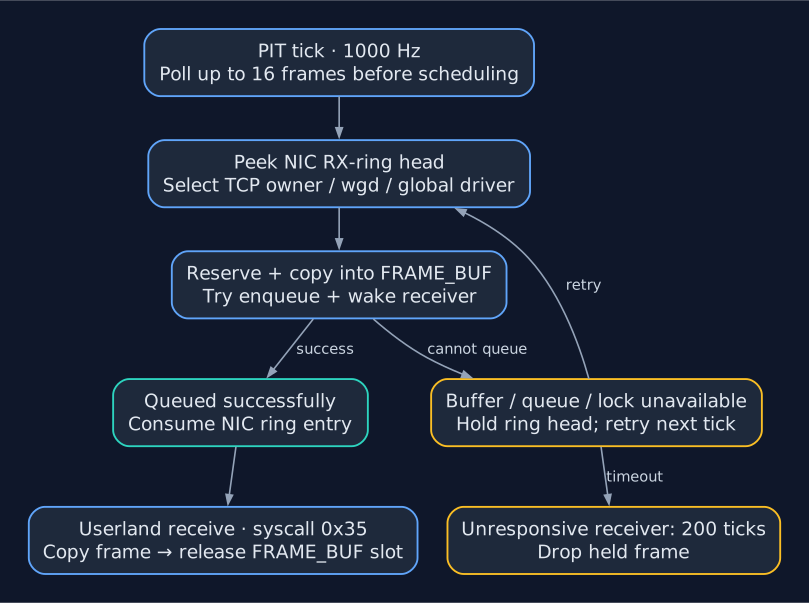
Network message ownership. The frame buffer lives until receive or process termination; a message queue entry carries its address and length.
Keyboard Pipe (IRQ 1 → userland)
User processes can subscribe to raw PS/2 scancodes via syscall 0x03 (pipe subscribe). The IRQ 1 handler writes each scancode byte into all subscribed circular buffers. A process reads its buffer with syscall 0x03 / 0x03 (pipe read). This is a polled, non-blocking path — the process must periodically call pipe_read rather than blocking.
Related documentation: Kernel Internals, Scheduler, Networking Overview, IPC Syscalls.