Kernel Internals
The kernel boots through GRUB and Multiboot2 into x86-64 long mode. It schedules
ring-0 tasks and ring-3 ELF programs, dispatches syscalls through int 0x7f, and
provides hardware access and filesystem mounts. TCP/IP stacks, the desktop and
application runtimes live in userland.
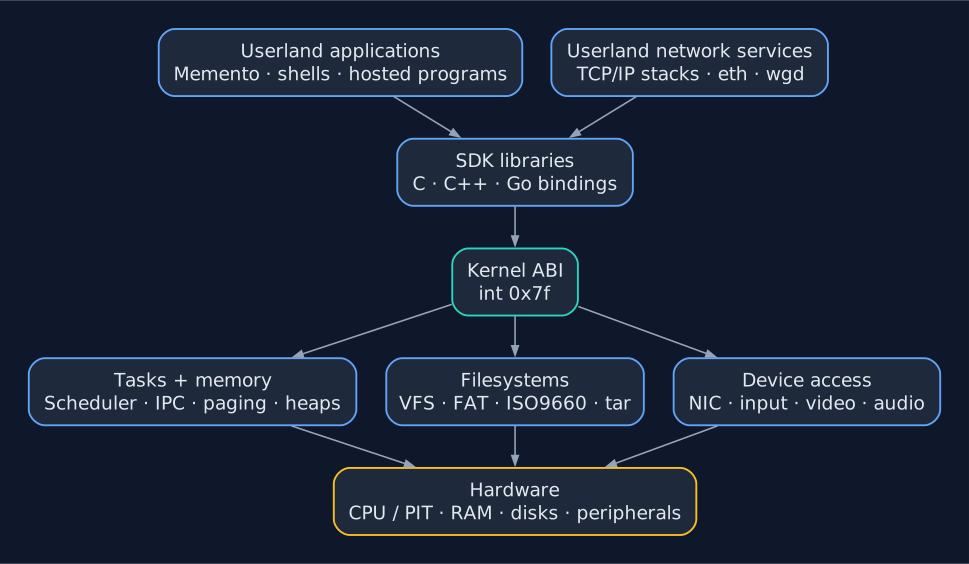
Kernel and userland responsibilities. TCP/IP connection state stays in userland; the kernel routes frames and exposes device access.
Start with Boot and Initialization, then follow the subsystem that owns the behavior you are investigating. For application development, use the SDK and ABI Specification.
| Subsystem | Guides | Source directory |
|---|---|---|
| Boot and initialization | Boot sequence, Subsystem setup, Build and Run | src/init/, iso/boot/boot.asm |
| Tasks and IPC | Scheduler, Processes, IPC | src/task/ |
| Memory | Memory map and paging, Allocators | src/mem/, linker.ld |
| Filesystems | VFS, RAM disk and boot archive, FAT12/FAT16, ISO9660 | src/fs/ |
| Networking | Routing and delivery, NICs and serial, Protocol helpers, WireGuard | src/net/ |
| Video | Framebuffer and capture, VGA | src/video/ |
| Audio | HD Audio PCM, Speaker and MIDI syscalls | src/audio/ |
| Input | Input routing, Keyboard, Mouse, USB firmware handoff | src/input/, src/usb/ |
Current Interfaces
There are 32 scheduler slots. Each ELF process has a private 2 MiB image and a
slot-specific initial stack; the shared user heap can grow beyond its initial
4 MiB. The writable RAM disk at /mnt/tmp and the read-only boot archive at
/mnt/tar allow application loading on machines without a floppy or CD driver.
The graphics session's init_rc task supervises Memento. A cooperative
desktop relaunch
replaces it after a Jug update while keeping the RAM disk and background services.
An ordinary session exit retains the reboot policy described in
Build and Run.
Networking supports RTL8139 and selected Intel NICs, loopback, and a userland
WireGuard daemon. Network monitoring
exposes physical NIC traffic totals and TCP port owners through syscalls 0x45
and 0x46.
Debugging and Validation
Use the text kernel's rescue shell for task, heap, mount, NIC, ACPI
and USB diagnostics. On either video path, /mnt/tmp/KERNDBG.LOG contains the
boot debug log. See Tests for host
unit tests, publisher tests and the QEMU kernel self-test.
Related documentation: Documentation home, SDK Overview, ABI Specification.