Input Overview
The input subsystem handles PS/2 keyboards (IRQ1), PS/2 mice (IRQ12), and USB
HID boot keyboards on xHCI controllers. PS/2 devices use the 8042 controller;
USB keyboards use a native driver polled from the timer interrupt. Both keyboard
paths deliver Set 1 scancodes to the shell and existing userland subscribers.
Port I/O primitives live in input/port.rs.
IRQ Wiring
| IRQ | IDT vector | Handler | Source |
|---|---|---|---|
| IRQ1 | 0x21 |
keyboard_handler |
PS/2 keyboard via 8042 port 0x60 |
| IRQ12 | 0x2C |
mouse_handler |
PS/2 auxiliary port via 8042 port 0x60 |
Both are registered in abi/idt.rs by install_isrs().
USB input uses IRQ0's scheduler timer to poll the xHCI event ring, before the scheduler acquires its lock. It does not require an xHCI interrupt handler. See USB keyboard support.
The 8042 controller shares a single data register (port 0x60) between keyboard and mouse. The status register (port 0x64) bit 5 distinguishes the source: 0 = keyboard, 1 = mouse.
Data Flow
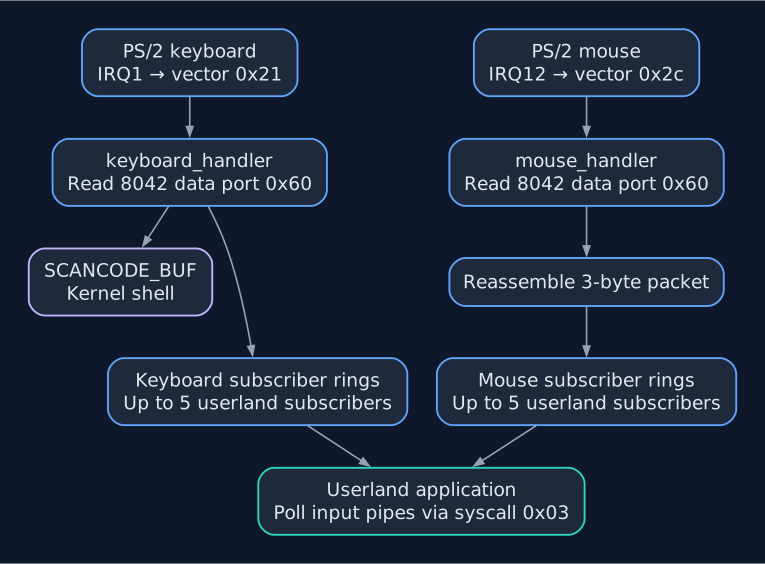
Keyboard scancodes and mouse packets use separate subscriber buffers. Reading
those buffers through syscall 0x03 is non-blocking.
Modules
| Module | File | Purpose |
|---|---|---|
keyboard |
input/keyboard.rs |
Scancode buffer, shell loop, scancode→ASCII, tab completion |
irq |
input/irq.rs |
Keyboard fan-out to up to 5 userland subscribers |
xhci |
usb/xhci.rs |
Controller ownership, DMA rings, USB enumeration and keyboard polling |
hid |
usb/hid.rs |
HID boot reports, Set 1 translation and held-key repeat |
mouse |
input/mouse.rs |
PS/2 mouse init, packet reassembly, subscriber ring buffers |
port |
input/port.rs |
Raw x86 I/O port primitives (IN/OUT for u8/u16/u32) |
cmd |
input/cmd.rs |
Shell built-in command dispatcher |
elf |
input/elf.rs |
ELF loader (run_elf) called by shell and syscall 0x2A |
elf_path |
input/elf_path.rs |
Validate bare names and explicit absolute executable paths |
PIC Configuration
The 8259A PIC is set up so that hardware IRQs are remapped to IDT vectors 0x20–0x2F (master 0x20–0x27, slave 0x28–0x2F):
- IRQ1 (keyboard) →
0x21(master) - IRQ12 (mouse) →
0x2C(slave, cascade through IRQ2)
The mouse init sequence (mouse::init) explicitly unmasks IRQ2 on the master PIC (0x21 &= ~0x04) and IRQ12 on the slave PIC (0xA1 &= ~0x10). Without these two clears, IRQ12 is permanently masked.
Port I/O Primitives (input/port.rs)
All hardware access goes through these wrappers around the IN/OUT x86 instructions:
| Function | Width | Instruction |
|---|---|---|
read_u8(port) |
8-bit | IN AL, DX |
write_u8(port, v) |
8-bit | OUT DX, AL |
read_u16(port) |
16-bit | IN AX, DX |
write_u16(port, v) |
16-bit | OUT DX, AX |
read_u32(port) |
32-bit | IN EAX, DX |
write_u32(port, v) |
32-bit | OUT DX, EAX |
read and write are aliases for the u8 variants and are used throughout the codebase.
Userland accesses port I/O through syscalls 0x30 (write) and 0x31 (read), which call these functions indirectly.
Related documentation: Kernel Internals, Keyboard, Mouse, Input Syscalls.